UN OWG Proposed Target 8.2
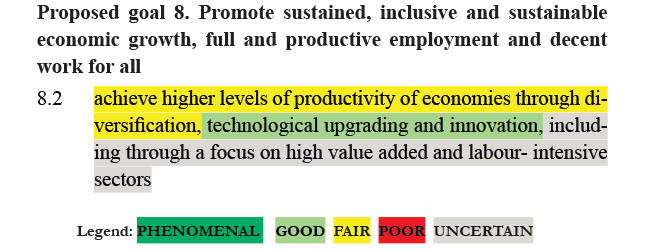
RATING: Increased productivity is an important and sound policy objective – which if done correctly confers numerous benefits. The difficulty is in implementation, particularly for structural transformations. Both the private sector and government have role to play, but typically private sector is better at driving productivity improvements.
Diversification
RATING: FAIR – diversification is important. However, diversification should not be driven top down, for example governments picking a portfolio of industries to support. Rather it should be driven via a bottom-up approach, through supporting conditions for entrepreneurship, which can naturally diversify a country’s industrial base
Technological upgrading and innovation
RATING: GOOD Generally, R&D has good benefits relative to costs though the difficulty in this target is obtaining the funds, resources and human capital to support innovation. Part of this will be developing the right conditions for innovation, and strengthening the innovation value chain to attract resources and talent. One caveat is Maskus (2014), which shows that raising R&D for developing and emerging economies beyond current trends through government expenditure or R&D credits will produce benefit-cost ratios in the FAIR range and even then, only between 1 to 2. Such countries would be better advised to invest in human capital and governance to establish solid frameworks within which knowledge spillovers from access to international technologies are optimized.
Focus on high value added and labour intensive sector
RATING: This part of the target depends on the mechanism used to achieve it. It can be very beneficial for countries, particularly LDCs, to integrate into existing regional and global value chains (PHENOMENAL), rather than creating their own industries (POOR) or non-market ‘job creation’ (POOR). Integration can be a valuable way to support manufacturing with benefits for both the domestic (more jobs) and international economy (increased productivity, lower costs). Governments’ role is to establish the conditions that attract foreign direct investment to link domestic enterprises to the global value chains.
Download the entire report
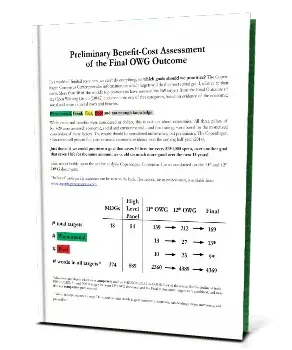
In our recent report, not just the target above, but all 169 targets have been assessed by 60 teams of the world’s top economists. The targets have been categorized into five ratings based on evidence of economic, social, and environmental costs and benefits. While we applaud that the UN Open Working Group's final outcome document contains 43 fewer targets than the previous document, we are concerned that many targets have simply been combined, therefore reducing the number of both phenomenal and poor targets assessed according to our cost-benefit analysis. Our new assessment includes suggestions for how these can be improved as reported in this article by the Financial Times.