

Clone 2 of TOP THREE PRIORITIES FOR BANGLADESH: TB, INFANT NUTRITION, E-GOVERNMENT
ONE-IN-ELEVEN DEATHS COULD BE AVERTED; BILLIONS OF TAKAS SAVED
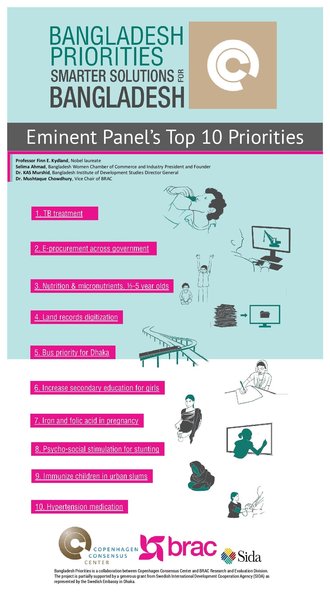 Our Eminent Panel, including a Nobel laureate economist and Bangladeshi economic experts, announced a prioritized list of investments that would produce phenomenal benefits for Bangladesh, saving billions of takas and averting one-in-eleven deaths.
Following the Copenhagen Consensus framework, the panel’s top priorities for Bangladesh were investment in tuberculosis (TB) treatment, infant nutrition, and e-government.
A Pioneering Project
For more than a decade, the Copenhagen Consensus approach has been applied at a global level – most recently to provide an economic input to the United Nations’ ‘Sustainable Development Goals’. This collaboration with BRAC is the first time it has been used at a national level.
"Bangladesh has a proud tradition for trailblazing ideas, distributing innovative BRAC solutions to many nations, and making microfinance a solution across the world. This project is a global first, and this once again makes Bangladesh a pioneer.” - Bjorn Lomborg
Compelling New Economic Research
The Eminent Panel (pictured below with Copenhagen Consensus Center president and founder, Bjorn Lomborg) considered well over 1,000 pages of new evidence on the costs and benefits of Bangladeshi policy options.

After public engagement and roundtables held with government, NGOs, and universities, seventy-six policy options were selected for analysis. More than 60% of the researchers in the project were Bangladeshi. The entire volume of new policy research has been placed in the public domain.
"This list will help both government and donors to prioritize future policy choices for Bangladesh. By encapsulating the social, environmental, and economic returns on cost, this provides us with a very valuable insight.” - Dr. Kas Murshid, Bangladesh Institute of Development Studies Director General
Tuberculosis
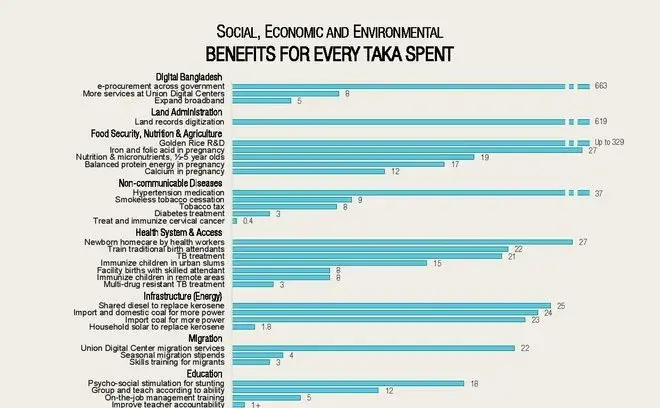
TB kills 80,000 Bangladeshis each year. Halting this death toll would stop nearly one in every eleven Bangladeshi deaths. Research by Dr. Anna Vassall, senior lecturer in health economics at the London School of Hygiene and Tropical Medicine, outlines a cost-effective TB treatment strategy using community health clinics that costs just Tk 7,850 per patient. Treating one person can save multiple lives. In total, each taka will achieve 21 takas of good. Learn more.
Digital Bangladesh
Bangladesh spends more than Tk 720 billion (Tk 72,000 crore) on public procurement annually. Making this process more efficient would avoid delays and cost overruns and increase efficiency. Research by Dr. Wahid Abdallah, a research fellow at the BRAC Institute of Governance and Development and Assistant Professor, BRAC University, shows that each taka spent on digital procurement will achieve 663 takas of good. In addition, research by Sultan Hafeez Rahman, Executive Director of the BRAC Institute of Governance and Development, finds that creating electronic land records would provide an incredible 619 takas of benefits per taka spent. Learn more.
"Digitizing land records is the type of policy that Bangladesh should prioritize. We need to embrace the digital age and secure property rights for women and men equally to unlock economic opportunities."- Selima Ahmad, Bangladesh Women Chamber of Commerce and Industry president and founder
Infant Nutrition
Bangladesh has had great success fighting hunger, but there is more work to do. Stunting affects around 6 million Bangladeshi children under age five, decreasing cognitive development, and leading to worse health outcomes, school performance, and productivity. New research by Jonathan Rose, a research advisor with the South Asian Institute of Advanced Legal and Human Rights Studies, examines programs to fight malnutrition by delivering nutrients and micronutrients to young children and pregnant mothers. Rose’s research estimates that if these supplements were delivered to everyone, stunting would fall from 36 percent to an estimated 29 percent—averting stunting in roughly 450,000 children. Learn more.
More Good Ideas
Other very high-ranked policy ideas for Bangladesh include:
- greater investment in transportation infrastructure to mitigate the need for private automobiles, motorcycles, auto-rickshaws and cycle- rickshaws;
- efforts to increase secondary school education for girls;
- providing iron and folic acid supplements during pregnancy, to improve health outcomes for mothers and their young children.
The Eminent Panel’s full findings are available here.
"Making choices is not an easy task. But if we want to get the best possible impact for our limited resources, it is essential to prioritize our options. The cooperation with Copenhagen Consensus Center has been a highly informative and valuable experience, and the results of Bangladesh Priorities will help BRAC specifically and the country in general set our future priorities."- Dr. Muhammad Musa, Executive Director of BRAC
The following is the full eminent panel ranking
| Rank | Intervention |
|---|---|
| 1 | TB treatment |
| 2 | e-procurement across government |
| 3 | Nutrition & micronutrients, ½-5 year olds |
| 4 | Land records digitization |
| 5 | Bus Priority for Dhaka |
| 6 | Increase secondary education for girls |
| 7 | Iron and folic acid in pregnancy |
| 8 | Psycho-social stimulation for stunting |
| 9 | Immunize children in urban slums |
| 10 | Hypertension medication |
| 11 | Union Digital Center migration services |
| 12 | Retrofit kilns, outdoor air pollution |
| 13 | More services at Union Digital Centers |
| 14 | Treat arsenic for 20% worst affected |
| 15 | Newborn homecare by health workers |
| 16 | Reform VAT and automate collection |
| 17 | Access to contraception |
| 18 | Golden Rice R&D |
| 19 | Expand village courts |
| 20 | RMG factory compliance |
| 21 | Balanced protein energy in pregnancy |
| 22 | Solid waste management in Dhaka |
| 23 | Multi-drug resistant TB treatment |
| 24 | Tobacco tax |
| 25 | Immunize children in remote areas |
| 26 | Facility births with skilled attendant |
| 27 | Shared diesel to replace kerosene |
| 28 | Import coal for more power |
| 29 | Calcium in pregnancy |
| 30 | RMG Palli special zone |
| 31 | Gasifier stove |
| 32 | Ultra-poor graduation programs |
| 33 | Skills training for migrants |
| 34 | Expand broadband |
| 35 | Diabetes treatment |
| 36 | Trade liberalization |
| 37 | Household solar to replace kerosene |
| 38 | Sanitation |
| 39 | Group and teach according to ability |
| 40 | Biomass cookstoves, indoor air pollution |
| 41 | Hand-washing promotion |
| 42 | Stormwater drainage in Dhaka |
| 43 | Transport infrastructure for Dhaka |
| 44 | Treat arsenic for all affected |
| 45 | Boost agricultural productivity |
| 46 | Early warning systems and shelters |
| 47 | Restoration of Buriganga river system |
| 48 | On-the-job management training |
| 49 | Smokeless tobacco cessation |
| 50 | Resettlement to manufacturing cities |
| 51 | Improve teacher accountability |
| 52 | Polders, flood level less than 3m |
| 53 | Padma Bridge |
| 54 | Improve school management |
| 55 | New hybrid kilns, outdoor air pollution |
| 56 | Trade facilitation |
| 57 | Treat and immunize cervical cancer |
| 58 | Seasonal migration stipends |
| 59 | Mangrove protection in Sundarbans |
| 60 | Livelihood programs |
| 61 | Flexible microfinance |
| 62 | Traditional microfinance |
| 63 | Vocational training |
| 64 | Provide BAU inputs like textbooks |
| 65 | LPG cookstoves, indoor air pollution |
| 66 | Unrestricted roads to North East India |
| 67 | Unconditional cash transfers |
| 68 | Unrestricted roads to Bhutan and Nepal |
| 69 | Import and domestic coal for more power |
| 70 | Computer assisted learning |
| 71 | Bond market |
| 72 | Polders, flood level more than 3m |